
Beyond the sand
Things to do in Gokarna besides the beaches
Gokarna was a pilgrimage town for a thousand years before it was a beach town. If the sea is rough, or you have simply had enough sand, there is a surprising amount within an hour’s drive.
Gokarna spent a thousand years as one of the most important Shiva pilgrimage sites in southern India before it spent twenty as a beach town. The beaches are genuinely good — see the Gokarna beach trek — but if the sea is rough, or it is raining, or you have simply had three days of sand, there is a great deal more within an hour's drive than most visitors realise.
This is the non-beach list, roughly in order of how far you have to go.
In Gokarna town
Mahabaleshwar temple and the Atmalinga
The reason the town exists. The temple houses a linga that sources describe as around 1,500 years old and which sits at the centre of the Ravana legend Gokarna is built around — the story of a linga brought here by deception and fixed in the earth, giving the town its name and its status as one of the great Shiva sites.
Practical notes: it is an active temple, not a monument. There is a dress code, a midday closure, and on Mondays and during Shivaratri it is extremely busy. Pilgrims conventionally visit the Maha Ganapati temple first, which stands a short walk away, before Mahabaleshwar. Phones and cameras are restricted inside. Go early.
Koti Teertha
A large man-made temple tank in the middle of town, traditionally held to contain water from many of India's holy rivers. Ancestral rites and ritual bathing happen here daily. It is a working religious site rather than a photo stop — be quiet, be observant, keep a respectful distance from families performing rites, and do not swim.
The town itself
Gokarna's main street is a single lane of old tiled-roof houses, brass shops, flower sellers and spice traders, and it is worth an hour on foot. The market is a good place to buy pepper, cardamom and cashew at a price that is not aimed at tourists. The car street and the temple approach are the oldest part.
Sunset from the headlands
The cliff between Kudle and Om has the best unbroken western horizon on this coast, and it is a fifteen-minute walk up from either beach. Take a torch for the way down.
Within half an hour
Mirjan Fort
Our pick for the best non-beach sight in the region. A 16th-century laterite fort just off NH66 between Gokarna and Kumta, attributed to Rani Chennabhairadevi of Gersoppa — the "Pepper Queen" — whose port here exported pepper, betel nut and saltpetre to Surat and Europe. It fell to the Marathas in 1757 and the British in 1784, and is now ASI-protected: a large, walkable ruin with bastions, stepped wells and tunnels.
It is the single best thing to do on this coast in the rain. Wet laterite goes almost black and the moss comes up. Full detail in places to visit in Kumta.
The Kumta beaches
Technically still beaches, but a completely different experience from Gokarna's — no shacks, no music, usually nobody at all. Vannalli, Baada, Nirvana at Kagal and Alvekodi are all within about ten kilometres of Kumta town, 26 to 35 km south of Gokarna. If what you are tired of is crowds rather than sand, this is the fix.
Dhareshwar temple
A quiet eight-hundred-year-old Shiva temple a few kilometres from Kumta, with almost no visitors. A completely different register from Gokarna's temple — no queue, no noise.
Within an hour or two
Honnavar backwaters and the mangroves
South of Kumta, the Sharavathi river spreads into an estuary of mangrove channels and islands, and a small boat through it at sunrise is the best thing on water on this coast. There is also a forest department mangrove boardwalk at Mavinakurve, and Basavaraj Durga island with a 1590 Vijayanagara fort on it, reachable only by boat. Between December and February the nesting beach at Kasarkod-Tonka brings olive ridley turtles ashore. Full detail on Honnavar backwater boating.
Murudeshwar
The 123-foot Shiva statue, the 249-foot 20-storey Raja Gopura with a lift to the top, and the best sea view on the coast from that lift. Plus scuba diving at Netrani island, 19 km offshore, which is the clearest water on India's west coast outside the Andamans. About 35 km south of Vannalli. See the Murudeshwar guide.
Yana rock formations
Inland, up into the Ghats: two black karst monoliths of 120 and 90 metres standing out of evergreen forest, with a Shiva cave shrine beneath the larger one. The approach from the Kumta side is a short walk; from Sirsi it is a proper 2.5 to 3 km forest trek. Allow about ninety minutes of driving each way from the coast. Detail on the Yana caves page.
Vibhuti Falls
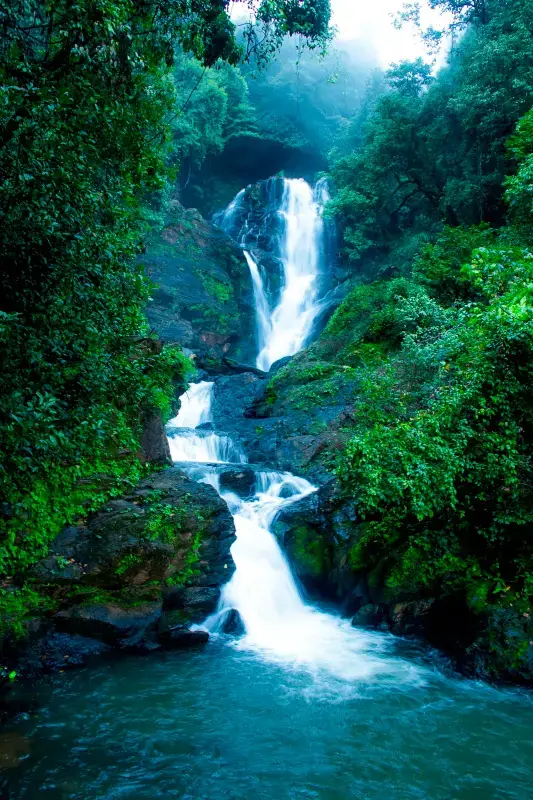
About 8 km from Yana, a tiered limestone cascade with a shallow pool at the base, and one of the few falls here that holds water well past the monsoon. Pair it with Yana; almost everyone does.
Jog Falls
Further inland via Honnavar and Sagara, and a long day out, but in August and September it is one of the great waterfalls in India. Low season it is a trickle down a cliff. Worth checking flow before committing the day.
Things to do rather than see
Yoga and retreats
Gokarna has a long-established yoga scene, concentrated around Kudle and Om beach, running everything from drop-in morning classes to multi-week teacher training. Quality varies enormously. If you want this, research the specific school rather than booking on arrival, and be aware that most of it shuts down in the monsoon.
Kayaking and water sports
Om beach has the organised water sports in season — jet skis, banana boats, parasailing — and kayaks are available on the calmer beaches. The backwaters at Honnavar are far better kayaking water than the open sea.
Eating properly
The beach shacks in Gokarna serve a pan-backpacker menu. The actual food of this coast is better and cheaper: Kane fry, fresh mackerel and surmai, prawn ghee roast, neer dosa, kori rotti, sol kadhi, and the local red rice. Eat in the town, or eat where you stay — we cook on site at Vannalli, and in the monsoon that is not a small consideration.
Fishing boats at dawn
Free, unorganised and better than most things you could pay for. The boats come in at first light at Gokarna main beach, at Alvekodi near Kumta and at a dozen points along this coast, and the sorting and selling on the sand is the real working life of the place.
What to do when it rains
The monsoon, June to September, shuts down swimming, all boats and the beach trek. It does not shut down this list. The best wet-weather plan:
- Mirjan Fort. Better in rain than sun, genuinely.
- Mahabaleshwar temple and Koti Teertha. Open, and much quieter than in season.
- Vibhuti Falls, and Jog Falls if you have the day. At full strength.
- The drive itself. The Ghats roads between Kumta, Sirsi and Yana in August are extraordinary. Do not do the ghat sections after dark.
- Doing nothing on a covered verandah while the sea comes apart in front of you. Underrated.
More on what the seasons actually do here in best time to visit Gokarna and Kumta.
Fitting it into a short trip
On a two-day weekend, pick the beach trek plus one of Mirjan Fort, Murudeshwar or Honnavar. Do not try to add Yana; it will eat the day. For a plan built around an overnight journey from Bangalore, see our Gokarna weekend getaway itinerary, and for how to get here, how to reach Kumta and Gokarna from Bangalore.
If you want forest and river as well as coast, the Dandeli and Gokarna combination is the three or four day version.
One thing to get right
Almost everything on this list is outside Gokarna town, and most of it is closer to Kumta than to Gokarna. Public buses run the highway well but not the last few kilometres to any of it. If this is the trip you want, sort out a scooter or a car on day one — it is the difference between seeing two of these and seeing eight.
Frequently asked questions
What is the Atmalinga at Gokarna?
The Mahabaleshwar temple at Gokarna houses a linga that sources describe as around 1,500 years old and that is central to the Ravana legend the town is known for. Pilgrims conventionally visit the Maha Ganapati temple first. It is an active temple with a dress code, not a monument.
What is Koti Teertha?
A large man-made temple tank in Gokarna town, traditionally held to contain water from many of India’s holy rivers. Ritual bathing and ancestral rites are performed there, so it is a place to be quiet and observant rather than to swim.
What can you do in Gokarna in the monsoon?
This is exactly when the non-beach list matters. The temples stay open, Mirjan Fort is at its most atmospheric in the rain, and the inland waterfalls at Vibhuti and around Yana are at full strength. Boats, the beach trek and swimming are all out.
Is there anything to do with kids?
Mirjan Fort is a good scramble, the Honnavar backwater boat trip works well for children, and Murudeshwar’s gopura lift is a reliable hit. The Gokarna beach trek is not suitable for small children because of the rocky cliff sections.